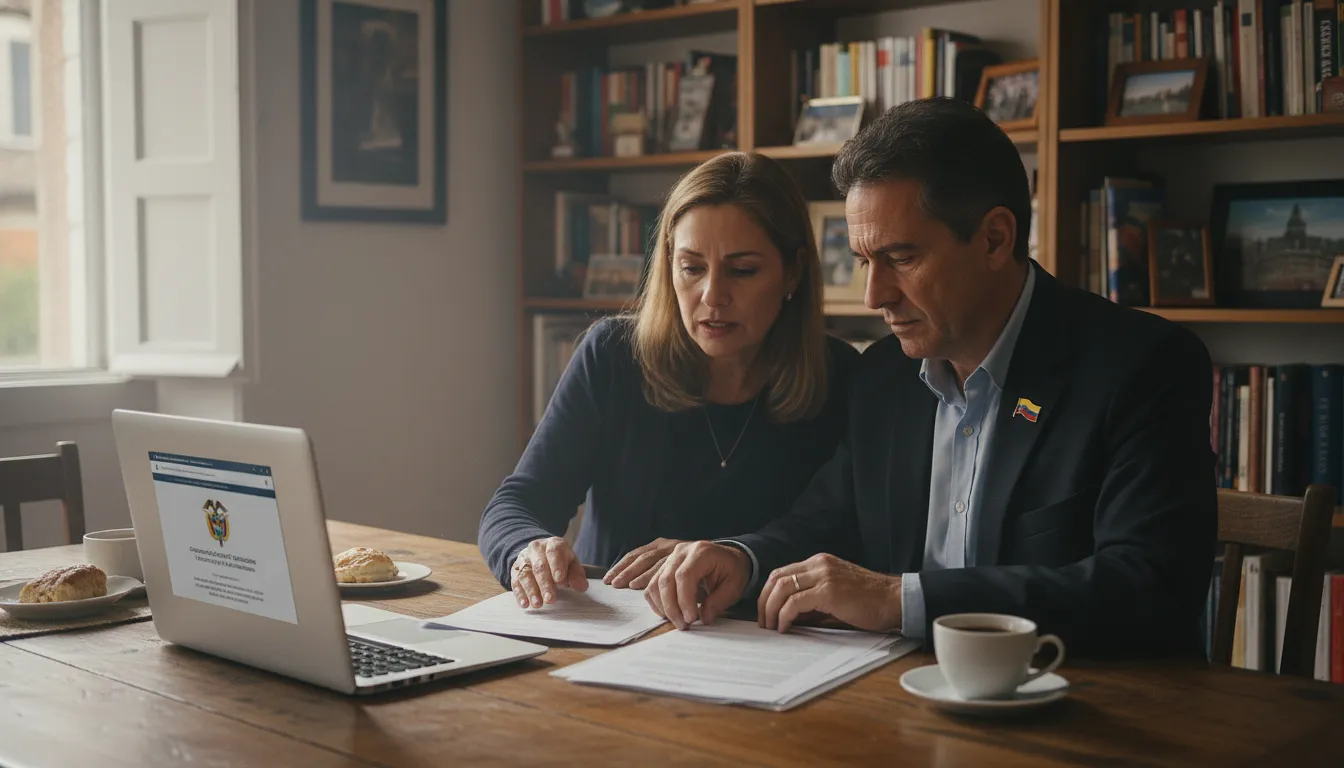
You worked hard for your Colombian pension. Are you sure you can actually claim it?
It's a situation we encounter regularly at our firm: a Colombian national has been living abroad for over a decade — perhaps in Spain, Canada, or the United States. They've been contributing to the local pension or retirement system in their country of residence, but they still remember the years they contributed to the Colombian pension system before they left. Now, as retirement approaches, they're realizing they have no clear picture of what they're entitled to, how to claim it, or whether any of those contributions are still working in their favor.
The question of pension rights for Colombians abroad is one of the most legally complex and most overlooked topics within the Colombian diaspora. The consequences of mishandling it — or simply ignoring it — can mean partial or total loss of pension rights that were built over decades of work.
This article offers a clear overview of the legal landscape: what rights you have, what risks you face, and why this is one of those areas where professional legal guidance isn't optional — it's essential.
Understanding the Colombian pension system: the legal framework that governs your rights
The Colombian pension system is primarily governed by Law 100 of 1993 and its subsequent reforms, most notably Law 797 of 2003. The system operates under two distinct regimes: the Régimen de Prima Media con Prestación Definida (a defined-benefit public system administered by Colpensiones) and the Régimen de Ahorro Individual con Solidaridad (RAIS) (a defined-contribution system managed by private pension funds such as Porvenir, Protección, Colfondos, and Old Mutual).
When a Colombian national emigrates, their relationship with these two regimes shifts dramatically based on several factors: how many weeks they contributed before leaving, whether they continued contributing from abroad, which regime they belong to, and — critically — whether a bilateral social security agreement exists between Colombia and their country of residence.
This last factor is frequently unknown to Colombians living overseas, and it can make an enormous difference. Colombia has signed social security conventions with countries including Spain, Chile, Ecuador, and Uruguay, and is a party to the Multilateral Ibero-American Social Security Convention, which covers most Spanish- and Portuguese-speaking nations. Under these agreements, contribution periods in both countries can, under specific conditions, be combined to meet pension eligibility requirements — a mechanism known as totalization.
However, the application of these agreements is not automatic. It requires a formal process, specific documentation, and coordination between the social security institutions of both countries. For Colombians residing in countries outside these agreements — including much of North America — the rules are different and the available options more limited.
The pension rights of Colombians living abroad sit at the intersection of national law and international treaty — a combination that requires careful, case-by-case legal analysis.
Why this matters more than most expats realize
Many Colombians abroad operate under the assumption that when the time comes, claiming their Colombian pension will be a straightforward process — a few phone calls, some paperwork, and done. This assumption is one of the most expensive mistakes we see in practice.
There is also a scenario that few people think about until it's too late: the indemnización sustitutiva (substitute compensation) or devolución de saldos (return of balance). Colombians who did not accumulate enough contribution weeks to qualify for a full pension are entitled to recover what they paid into the system — but pursuing this from abroad involves bureaucratic hurdles that can take years to resolve without proper legal representation.
Additionally, Colombians who remain employed by Colombian companies or who work as independent contractors with Colombian clients are legally required to continue contributing to the Colombian social security system even if they live outside the country. Failure to comply generates debt with interest and can seriously complicate future pension claims.
Have questions about your specific obligations from abroad? Contact us for a personalized consultation.
The general process: more complex than it looks from the outside
Without getting into the specific steps — which vary considerably depending on individual circumstances — accessing a Colombian pension from abroad generally involves the following dimensions:
1. Verifying your contribution history
Before any formal procedure, it's essential to have a precise picture of how many weeks or months you contributed, under which regime, and whether any transfers or discrepancies exist in the system. Errors in Colpensiones or private fund records are far more common than most people expect, and correcting them from outside Colombia adds a significant layer of difficulty.
2. Determining which agreements apply and how
This is the most technically demanding aspect. Depending on your country of residence, a bilateral agreement may or may not be applicable. If it is, activating the totalization of contribution periods requires coordinating between social security institutions in both countries, following specific procedures with their own timelines and required formats. A misstep at this stage can result in the loss of weeks of foreign contributions that could have been decisive.
3. Filing and managing the pension application
The formal pension application — whether to Colpensiones or a private fund — can be submitted from abroad, but it requires apostilled documentation, notarized powers of attorney, and in some cases the involvement of a legal representative physically present in Colombia. Legal response timelines exist on paper, but knowing how to enforce them from overseas is a different matter entirely.
4. Receiving payment from abroad
Once the pension is officially recognized, receiving payments from outside Colombia involves additional banking procedures and, in many cases, tax implications in both Colombia and the country of residence. Planning for this stage in advance can prevent unpleasant surprises after years of waiting.
This is precisely the stage where having a Colombian lawyer by your side makes the difference between receiving your pension on time and waiting years longer than necessary.
Common mistakes that put your pension at risk
Based on our experience advising Colombians abroad, here are the most frequent errors we encounter — and the real consequences they carry:
Mistake 1: Assuming contribution periods abroad are automatically combined
Many people believe that because a treaty exists, their foreign contribution weeks will automatically be added to their Colombian record. In reality, totalization is a benefit that must be explicitly requested and supported with specific documentation from the foreign social security authority. Those who don't pursue it properly can lose weeks that would have made the difference between qualifying and not qualifying for a pension.
Mistake 2: Leaving the private pension fund without understanding the consequences
When emigrating, many Colombians simply stop contributing to their private fund without requesting a transfer or voluntary continuation. Depending on accumulated balance and age, this can result in significant losses in projected returns or affect eligibility for the minimum pension guarantee — a protection that many people don't realize they may be entitled to.
Mistake 3: Outdated contact information and beneficiary designations
It may seem trivial, but Colpensiones and private funds send critical communications — including resolution notices and document requests — to the address and email on file. If that information is outdated, the applicant can miss deadlines that, if not met, require restarting the entire process from scratch.
Mistake 4: Managing everything without a legal representative in Colombia
Some procedures before Colpensiones require in-person presence or the intervention of a legally authorized representative in the country. Colombians who try to manage everything from abroad through relatives without a valid notarized power of attorney face rejections, delays, and in some cases, the loss of procedural deadlines that are very difficult to recover.
Mistake 5: Ignoring the tax dimension
Colombian law establishes specific withholding rules for pensions depending on the amount, and the status of being a non-resident for tax purposes in Colombia changes how those rules apply. Additionally, several countries have double taxation treaties with Colombia, but their application is not automatic and must be actively invoked. Failing to plan for this aspect can mean an unexpected tax bill that significantly reduces the real value of years of contributions.
Most of these mistakes are entirely preventable with the right guidance before any process begins. Once made, correcting them from abroad can take years.
Frequently asked questions
Can I receive my Colombian pension if I've lived outside Colombia for over 10 years?
Yes. Residing abroad does not cancel your right to a Colombian pension. What matters is whether you meet the contribution week and age requirements established under Law 100 of 1993 as amended by Law 797 of 2003. If your Colombian contributions alone are insufficient, whether you can supplement them with foreign periods depends on your country of residence and the applicable treaties. A review of your specific history is necessary to give you a reliable answer.
What happens if I didn't contribute enough weeks in Colombia?
If you reach pension age without the required weeks of contribution, you may have the right to an indemnización sustitutiva through Colpensiones or a devolución de saldos through a private fund. These are different mechanisms with different procedures, timelines, and effects on any future pension rights. In some cases, voluntary contributions to complete the missing weeks may be an option — but this path has conditions and limitations that need to be understood before committing to it.
Can my Colombian pension be deposited into a foreign bank account?
In many cases, yes — but the exact mechanism depends on your country of residence, the type of account, and the arrangements available through the paying institution. There are transfer costs, potential source withholdings, and currency considerations that vary significantly by case. Getting a concrete answer to this question requires a review of your specific situation, and it's wise to plan for this before finalizing the pension recognition process.
Will I be taxed in Colombia on my pension if I live abroad?
Colombian tax law establishes specific rules for pension income based on the monthly amount received, and your status as a fiscal non-resident in Colombia affects how those rules apply to you. Several of Colombia's double taxation treaties may reduce or eliminate withholding at source, but invoking them requires affirmative steps. This is a topic worth addressing jointly with a Colombian lawyer and, if needed, a tax advisor in your country of residence — because the interaction between the two tax systems is rarely straightforward.
Your pension doesn't wait — and neither should you
The question of pension rights for Colombians abroad is one where inaction has a direct economic cost. The Colombian pension system was designed with residents in mind; adapting it to the reality of life overseas requires a detailed understanding of national law, international agreements, and the bureaucratic procedures that connect them — all of which can be opaque even for people living in Colombia.
If you are a Colombian national living abroad and you have contributions in the Colombian pension system — whether in Colpensiones or a private fund — the right time to review your situation is not when you reach retirement age. It's now, while there is still time to correct course, complete missing contributions if applicable, and prepare the documentation that will make the process as smooth as possible.
At Legal Diligence Medellín, we work with Colombians abroad on every aspect of pension recognition, management, and payment — from the initial review of contribution history to representation before Colpensiones and private funds, and coordination with foreign social security institutions where treaties apply. We know this system, and we know how to navigate it on your behalf from wherever you are.
Have questions about your case? Contact us for a personalized consultation. One conversation can save you years of unnecessary procedures — and make sure the rights you've earned are actually protected.